Batteries
Battery setups depends on the particular device.
Battery cells need to be handled with care, see this discussion about those batteries, for example. So far it seems most folks use normal "unprotected" cells in various devices, without any problems. As long as you handle the batteries with care, you should be fine.
18650
The Heltec v4 prebuilt kit and the SenseCAP Solar Node P1, like many other devices, uses 18650 battery cells.
Sizes
18650 batteries look like bigger AA batteries, but they are not "C" or "D" batteries either: they are longer and thinner than a "D". 18650 batteries are named after their size: 18mm wide, and 65mm long.1
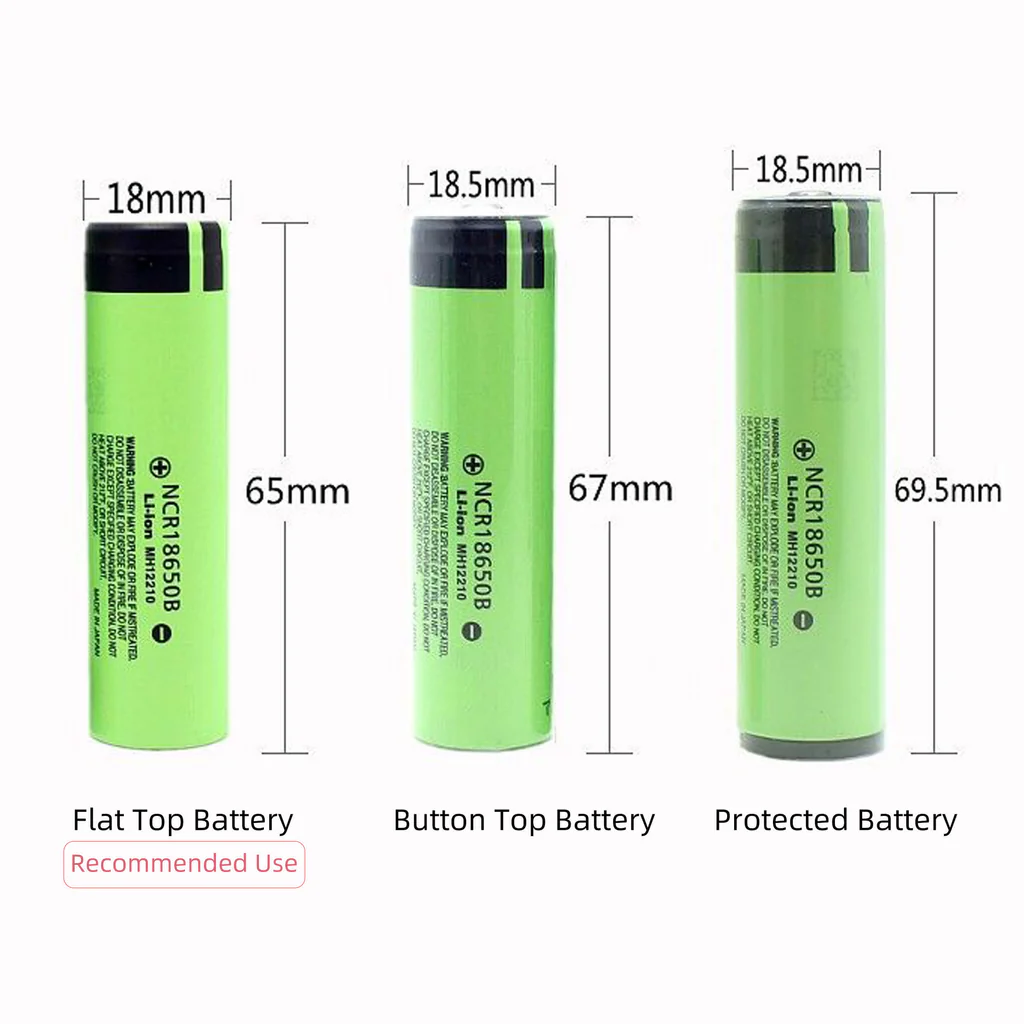
They are not all exactly that same size: some 18650 batteries have a "button" (like the positive side of AA batteries) and some are "flat" (like negative size, but on both ends). Some have a "protection" circuit inside that makes them even longer.
This makes some 18650 batteries fit in one case and not another. A "buttoned" battery might not fit in a case because it's too long and a "flat" battery might fit but not connect at all because it is not long enough!
In particular, we found out that:
- the Heltec v4 prebuilt kit requires flat top batteries and even then, they are tight and hard to remove
- the SenseCAP Solar Node P1 requires button top batteries, otherwise you will not be able to use or charge the batteries reliably
Tip
Here's an example of 3 batteries from the Lilygo website:
Where to buy
You can buy those batteries in "vape shops" and various electronics shops also hold stock:
- Addison: has 5-10$CAD flat batteries near the LEDs desk at the St-Michel store, not on the website
- Abra: Samsung 25R 18650 2500mAh 20A (flat) for 10$CAD
- Mastervox: 3.7V 3000mAh (button) for 10$CAD, based in Joliette and Longueuil
- Veshra:
EVE 35V INR186503500mAh 10.2A (flat) for 6$CAD - AliExpress:
Kuugro ku-350018650 Battery 3500mAh 3.7V 12A (button) for 2$CAD, 90$CAD for 20, price varies according to your visit, current sweet spot is actually 8 batteries for 46$ (5.75$CAD/battery) - MP&W: Button Top EVE 35V Battery Cell, Single Cell (button) for 8.50$CAD, spot-welded buttons from a Ottawa maker, EVE 35V 18650 3500mAh (flat) 6 for 36$
Pouch cells
Those cell packs are more used in DIY kits or lab setups:
Below freezing
Contrary to popular belief, it seems like lithium-ion batteries work fine below freezing although we still need to confirm the results from the folks in Calgary ourselves. The Calgary folks are using plain unprotected batteries below freezing without issues.
For really remote relays that are difficult to service, they started using LTO batteries which are better suited to handle deep freeze -- we're talking -40℃ on mountaintop -- conditions.
Charger
You might also want to have a charger if you deal with a lot of 18650 batteries.
Warning
Do not try to charge 18650 batteries in a normal "AA" battery charger! They won't fit and it won't work.
You don't need a charger for a single device: devices normally come with their own charge controller and can charge over whatever power source they normally use (USB-C, Solar, etc).
It is just nice to slot them in a device already charged, and they are not necessarily sold charged.
- Abra: 4-battery charger, 15$: works well, LEDs turn green when full, needs a 5V 1-2A USB-A power supply (not included), 1A output
- Addison: "universal" 4-battery charger, 60$: untested, seems overpriced, includes cigarette lighter adapter and AC power plug, 1A output
-
Wikipedia claims the 0 is the digit after 65mm ("65.0mm"). ↩